

Laufkadenz
Running Cadence: Why Your Step Rate Matters More Than Your Pace
- Published
- Reading time
- 5 min
- Author
- Athlix Performance
You train for weeks to hit your target pace, monitor your heart rate and kilometre splits – but one of the most effective levers for greater efficiency and fewer injuries lies in a metric that many runners barely pay attention to: running cadence.
Running cadence, steps per minute – the term sounds technical, but it is simple: it refers to how many steps you take per minute. This figure has a surprisingly large influence on how economically you run, how much strain you place on your joints, and how fast you become. Anyone who understands their cadence and deliberately improves it will not only run more efficiently but also protect themselves from common overuse injuries such as runner’s knee or shin splints.

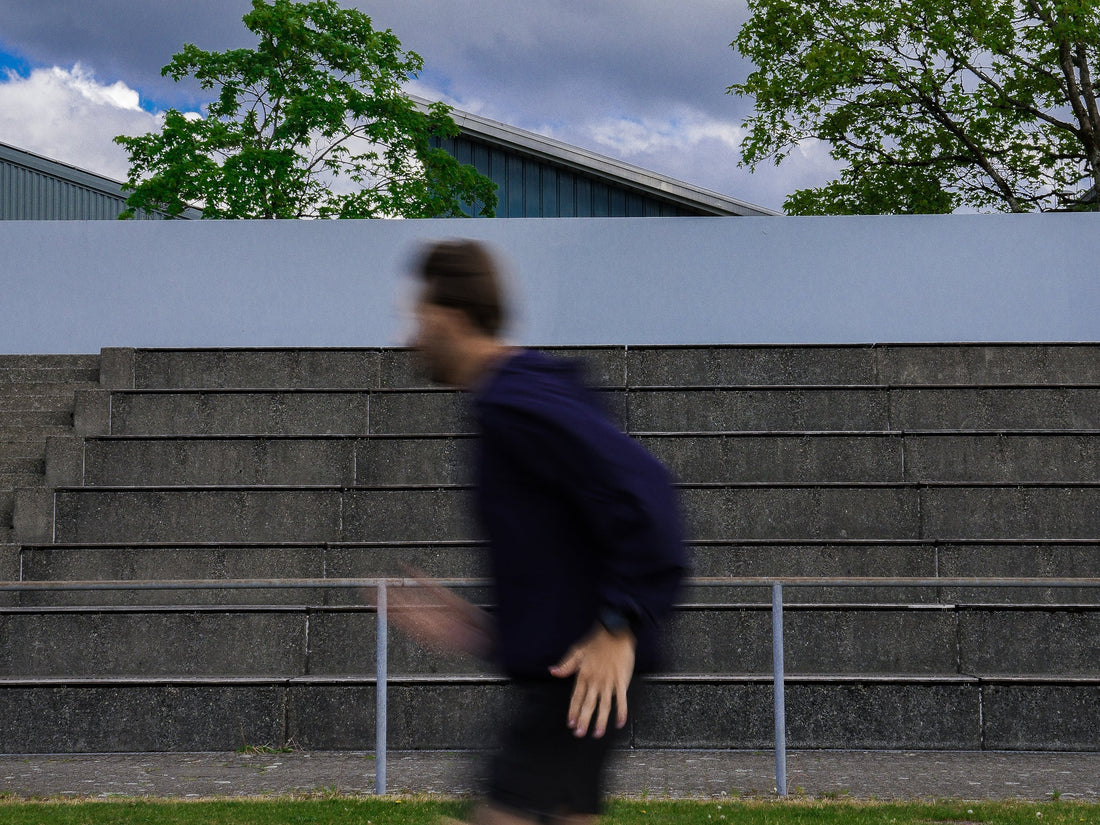
Cadence in motion – cadence determines pace and efficiency.
What running cadence really means
Cadence is measured in steps per minute (SPM) – the number of steps you take in one minute with both legs. Modern GPS watches and running apps now display this value in real time. Recreational runners typically fall within the range of 150 to 170 SPM, while elite track and field athletes often reach 180 SPM or more. At the 1984 Olympic Games, running coach Jack Daniels observed that nearly all top runners competing over distances longer than 1500 m had a cadence of at least 180 SPM – and this figure has since become the unofficial benchmark of the running world.
What is happening biomechanically? A higher cadence generally means shorter strides. And shorter strides mean that you land your foot closer to your centre of gravity – rather than far out in front of you. This reduces braking forces with every impact, relieves stress on your knees and hips, and reduces the vertical movement of your body, known as “bouncing”. The result: you become more efficient and more resistant to injury at the same time.
Understanding your cadence
What your cadence says about your running style
Under 150 SPM
Critical range
Stride is too long, creating strong braking forces with every impact. Significantly increased risk of knee and shin problems.
150 – 165 SPM
Typical recreational runner
The most common range for beginners and occasional runners. A gradual increase is recommended – there is potential for improvement.
165 – 175 SPM
Good recreational runner
A solid range for runners who train regularly. Biomechanically, already significantly more efficient than lower frequencies.
175 – 180 SPM
Advanced runner
Optimal range for most running paces. Shorter ground contact times, lower joint stress, and good running economy.
180+ SPM
Elite & race pace
Typical for elite track and field athletes at race pace. Often unnatural at slower paces—the key is the context of the pace.
5–10 %
Recommended increase
4–6 wk.
Until the pattern is internalized
30 sec.
Measure it yourself
Values based on sports science findings (Cureus Systematic Review, PMC Running Kinetics Study).
What the science actually says
So, is 180 SPM the universal optimum? Not quite. A recent systematic review in the journal Cureus shows that a moderate 5–10% increase in running cadence over one’s natural rate produces measurable biomechanical benefits—reduced ground reaction forces, lower loading rates on bones and tendons, and better alignment of the hip and knee joints. All without compromising running economy.
At the same time, another study on the relationship between running speed and cadence shows that the optimal step rate depends heavily on pace: During an easy run, a target of 180 SPM feels unnaturally high for many runners; during a tempo run or race, however, it is often exactly right. The takeaway: Don’t train blindly for 180—analyze your own cadence strategically and improve it gradually.
Improve your cadence—here’s how
Cadence training requires no special equipment—only awareness and patience. These are the four most effective approaches:
- Establish your baseline: First, measure your current step rate during an easy run. Count the steps of one foot for 30 seconds and multiply by 4. Or use your GPS watch if it offers cadence tracking. Only once you know where you stand can you increase your cadence strategically.
- Gradual 5–10% increase: Never increase your cadence abruptly. If you currently run at 158 SPM, aim for 165 initially. Your musculoskeletal system needs 4–6 weeks to internalize the new pattern. Changes that happen too quickly can lead to muscle tension or pain.
- Use a metronome or music: Running playlists with the desired BPM are an elegant way to intuitively build toward your target cadence. Metronome apps provide direct audio feedback—many runners find that the rhythm makes the increase happen almost automatically.
- Include strides: Add 4–6 short strides (over 80–100 m) at the end of your easy runs. Focus consciously on quick, light steps—perfect for training the pattern without increasing the overall load.

How your foot lands determines both efficiency and injury risk.
The most common mistakes and how to avoid them
The biggest misconception is forcing cadence to 180 SPM at every distance and every pace. Anyone who rigidly takes 180 steps per minute at a pace of 5:30 min/km ends up running with unnaturally short mini-steps that cost more energy than they save. Cadence must always be viewed in the context of running pace—the faster you run, the higher your frequency naturally becomes.
Another mistake is training cadence in isolation without paying attention to the rest of your running technique. Arm drive, core stability, and hip extension play an equally important role. If you run with small, quick steps but lean forward at the same time or barely move your arms, you’re wasting your potential. Better: use video analysis with a training partner or running coach to assess the whole picture.
Athlix recommendation—the setup for clean running technique
Anyone who wants to test their improved cadence directly under race conditions will find the perfect opportunity at the ZKB Zürilauf Cup—a popular race series with various distances across Switzerland. And with the Athlix Tempo Run Essentials Socks, you’ll run with an optimal fit and the right feedback directly at your feet—because every good running technique starts with the right foundation.
Conclusion
Running cadence isn’t theory for elite athletes—it’s one of the most accessible levers you have as a runner. Just 5–10% more steps per minute can mean less pain, better running economy, and faster times. Start today: measure your current cadence, set a realistic goal, and systematically build the increase into your next four weeks. Your body—and your splits—will thank you.
Try it out and tag us on Instagram at @athlix.performance – we love seeing how you improve your cadence, and we share the best posts with the community.