

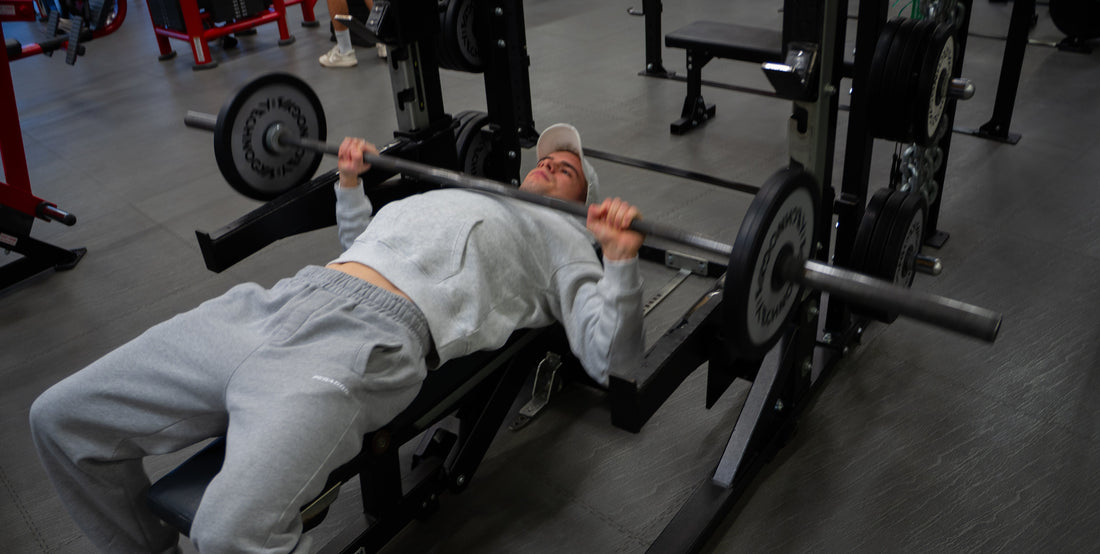
Gym Outfit
The Perfect Gym Outfit: What Really Matters
- Published
- Reading time
- 3 min
- Author
- Marvin Ziegler
There's that moment in every session where everything is decided. Not in front of the mirror, not walking in, not at the first photo. It's when your pulse climbs, the set turns gritty, and you notice: either you're in flow — or you're just busy.
Adjusting sleeves. Pulling up the waistband. Tugging the fabric back into place. That's exactly where you see whether your outfit supports you or pulls you out of focus. A gym outfit doesn't have to be loud. It has to deliver. When the fit is right, the material doesn't bother you, and you can move freely, training suddenly gets cleaner — not because it's any less hard, but because there's less friction in your head.

Outfit dialed in. Focus dialed in. The rest is repetition.
Why your outfit affects your performance
Sport psychology calls it "enclothed cognition": the clothes you wear demonstrably affect your self-perception, your behavior, and even your performance. A PubMed review shows: those who wear performance gear focus better, more often bring their full potential, and less often cut hard sessions short.
In Switzerland there's an extra practical angle: the walk to the gym is often cold in winter, it's warm inside, and afterwards you head back out. A good setup isn't just a shirt and pants, it's a system of layers that work together.
The 4 basics of your gym outfit
What really matters — beyond the look
Basic 1
Fit & freedom of movement
Full range of motion in squat, overhead and pull. Nothing should pinch or slip.
Basic 2
Material quality
Test after 30–60 min of sweating. No chafing, no heavy cling, no loss of shape.
Basic 3
Layering system
Base layer, mid layer, hoodie. Adjustable to outside and indoor temperature.
Basic 4
Details & construction
Seams, collar, waistband — nothing should bother or scratch during the session.
3-layer
Tee + hoodie + jacket
60 min
Sweat test
0
Friction points
Athlix Performance standards — inspired by research on enclothed cognition (Adam & Galinsky).
Three outfit formulas that work in practice
Instead of hunting for the perfect single piece, think in combinations. These three formulas cover most training styles:
- All-round (training without changing): T-shirt as a base, shorts or joggers with a stable waistband, plus a hoodie for warm-up and after. The safest choice for strength, machines, free weights and short cardio blocks.
- Oversized (statement with control): Oversized tee or hoodie as the top layer, a clean base underneath. Slimmer on the bottom so the silhouette stays athletic. Ideal as a pump cover, for warm-up, or for heavy days.
- Winter (Swiss setup): Joggers plus hoodie for the commute, then switch to shorts or a lighter layer in the gym depending on the session. You don't start cold, you don't sweat through everything, and you don't walk out "open" after training.
- Recovery day: Easy sweater or hoodie, loose pants, comfy sneakers. Comfort matters here, not performance. But: same look standard — you represent your discipline at rest too.

Focus doesn't start in the gym — it starts on the way there.
The most common outfit mistakes
The biggest mistake: focusing only on the look and ignoring the material. A shirt that looks great but chafes after 20 minutes of sets costs you concentration and therefore performance. Invest in a few high-quality pieces instead of many cheap ones.
Second mistake: trend-chasing. Every season new cuts, new colors, new brands. It's smarter to have a clear setup of three or four combinations that cover all your sessions. If you hesitate two seconds at checkout because something isn't quite right — leave it. That's usually the moment you'll later regret having bought it anyway.
Athlix Recommendation — essentials that clean up your closet
If you want to simplify your setup on purpose, the combination of tee as a base and hoodie as a layer is the fastest lever. For exactly that combination, see our Hoodies Collection and the T-Shirts Collection. Both are built for sessions where you don't want to think about the fabric.
Conclusion
The perfect gym outfit doesn't happen by accident, and it doesn't happen by chasing the next trend. It happens when you build a setup that goes quiet during training: you don't think about it, you don't adjust anything, you're just in it. Fit, material, layering, details — those are the four levers that make the difference. Buy less, buy better, buy deliberately.
Give it a try and tag us on Instagram @athlix.performance — we love seeing what your outfit setup looks like, and we share the best posts with the community.