

Kaufberatung
Cotton or Synthetic? The Right Running Shirt for Hot Days
- Published
- Reading time
- 5 min
- Author
- Athlix Performance
Kilometer 8, 29 degrees, and your shirt is clinging to your back like a wet towel. That’s not bad luck—it’s fabric science.
You researched your shoes, your watch knows your HRV, and your gel timing is dialed in. Then you head out in the cotton shirt from last year’s company run in the height of summer. No garment is more underestimated than a running shirt—and none has a more direct impact in summer on whether a session feels easy or grueling. It’s time to understand what you really need to look for when buying one.

Same shape, completely different behavior: the difference lies in the fiber, not the cut.
What happens in the fabric while you sweat
When you run, you produce heat—and the most important way to get rid of it is through the evaporation of sweat from your skin. Your shirt is either helping or creating a barrier. Cotton is hydrophilic: it absorbs moisture and holds on to it. Its official moisture regain is around 8.5 percent of its own weight, while polyester’s is only about 0.4 percent. Polyester therefore absorbs very little water, but spreads it across the fiber surface and moves it outward, where it can evaporate—this is known as capillary action or “wicking.”
But it’s important to put this in perspective: According to an analysis by the Sport Information Resource Centre, there is still no independent study proving that performance fabric directly improves your performance. At an easy to moderate pace, core body temperature differs little between cotton and synthetics. What does differ measurably is skin temperature, the weight of the garment when wet and—most importantly—comfort at high intensity. Wet cotton becomes heavy, rubs and chafes. That’s exactly where you decide whether you enjoy the final kilometers or simply endure them.
Fabric science: Which fiber for what
Moisture absorption, behavior and ideal use of the four most common shirt materials
Cotton · approx. 8.5% moisture absorption
Soft, absorbent, slow-drying
Comfortable against the skin and naturally odor-resistant, but heavy when wet and stays that way. Ideal for lifestyle wear, warm-ups, cool-downs and easy sessions under 30 minutes.
Polyester · approx. 0.4% moisture absorption
Lightweight, quick-drying, shape-retaining
Moves sweat outward instead of storing it. The first choice for speed sessions, long runs and races in the heat. Drawback: more prone to odor.
Blend · Cotton/polyester
The everyday compromise
Soft feel and somewhat faster drying than pure cotton. Good for gym training and changing levels of exertion—but in hot runs, it is no substitute for pure synthetics.
Merino wool · approx. 15% moisture absorption
Temperature-regulating, odor-resistant
Absorbs a lot of moisture without feeling wet and stays remarkably odor-free even after several sessions. More expensive, more delicate and heavier than synthetics.
8.5%
Cotton moisture
0.4%
Polyester moisture
120–160 g
Ideal summer fabric weight
Sources: official textile moisture regain values according to textile standards; classification based on the Sport Information Resource Centre (SIRC), 2018.
How to recognize a good running shirt
Fabric is only half the equation—the other half is construction. Check these five points in the store or as soon as you unpack it:
- Fabric weight: For summer runs, the sweet spot is 120–160 g/m². Below that, the fabric becomes transparent and delicate; above that, it traps heat. Hold the shirt up to the light—if you can clearly see your hand through it, it’s fine for races but too thin for everyday wear.
- Seams: Flatlock or bonded seams belong under the arms and at the shoulders. Traditional overlock seams in high-friction areas are the most common cause of chafing on runs longer than 60 minutes.
- Fit: A running shirt should sit close to your torso without feeling restrictive—that’s the only way moisture transport works properly. Too loose means pockets of air and flapping; too tight means friction. Raise your arms above your head: if the hem rides up significantly, the cut is too short.
- Construction: Gently pull on the side seam. Visible gaps between the stitches or a wavy seam are warning signs. A cleanly finished neckline will retain its shape after ten washes; a cheaply made one will stretch out.
- Safety testing: The OEKO-TEX Standard 100 label means that all components—outer fabric, sewing threads, labels and prints—have been tested for substances hazardous to health. Particularly strict limits apply to textiles that have intensive contact with the skin.

Close-fitting cut, lightweight fabric, flat seams—that’s what a shirt looks like when it stays out of your way in the heat.
The odor misconception: Why your performance shirt starts to smell faster
The most common criticism of synthetics is: “That stuff smells after one session.” And the criticism is valid—just not for the reason most people assume. For a study published in Applied and Environmental Microbiology, a team led by Chris Callewaert collected the shirts of 26 participants after an intense spinning session and left them for 28 hours. The result: The polyester shirts smelled significantly stronger and more unpleasant than the cotton shirts.
The cause isn’t sweat itself—fresh sweat is practically odorless. Only bacteria break down long-chain fatty acids into small, volatile molecules. And certain bacteria, known as micrococci, grow significantly better on polyester than on cotton. They were found almost exclusively on the synthetic shirts. The takeaway isn’t to “go back to cotton,” but to wash your performance shirt promptly after your run, skip fabric softener (it coats the fiber and blocks moisture transport) and wash it inside out at 30–40 degrees. Air-dry it rather than using the dryer—heat damages elastane fibers.
What this means for your wardrobe
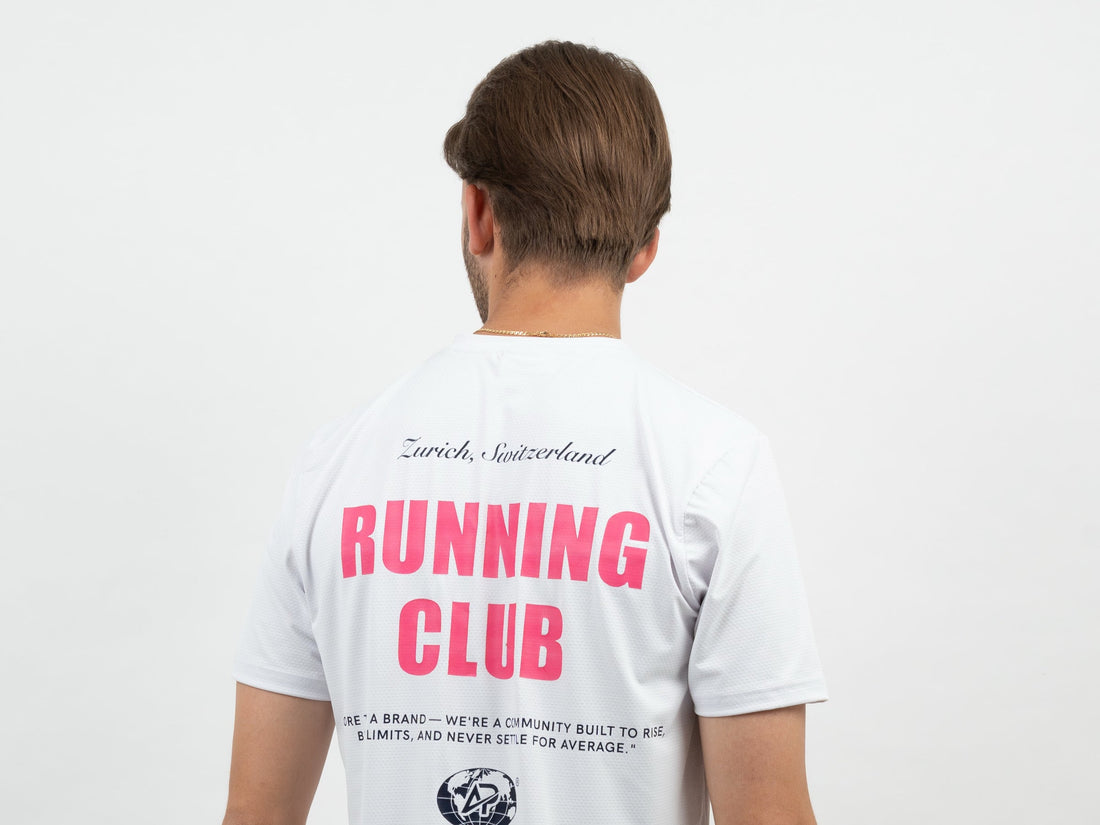
You don’t need one perfect shirt; you need two clear roles. For speed training and long runs in the heat, a polyester shirt like the Running Club – Performance T-Shirt works for you: lightweight, quick-drying and cut close to the body for running. For warm-ups, cool-downs, strength sessions and the walk to the café afterward, cotton is the more comfortable choice—a Chase Miles – Essentials T-Shirt serves exactly that purpose. The mistake isn’t owning cotton. The mistake is taking it out for a long run when it’s 30 degrees.
Bottom line
No shirt will make you faster—that’s what the research makes quite clear. But the right material determines how you feel at kilometer 15, whether your skin stays intact and whether you even feel like doing the session in summer. Focus on fabric weight, seams and fit rather than marketing claims, and choose your shirt for its intended use—not the other way around. A well-chosen running shirt costs you a moment of attention when you buy it and pays you back over hundreds of kilometers.
Try it out and tag us on Instagram at @athlix.performance—we’d love to see how you’re logging your summer kilometers and will share the best posts with the community.