

Layering
Layering for running: how to dress right in November
- Published
- Reading time
- 5 min
- Author
- Athlix Performance
The cold bites your fingers on the first step out the door, and two kilometres later your shirt is sticking to your back. Welcome to November.
Hardly any season makes dressing for a run as tricky as late autumn. 3 °C and fog in the morning, 11 °C and sunshine at midday, plus a cold wind off the lake. Put on too much and you are running in your own sweat after ten minutes. Put on too little and you cool down at every traffic light. The answer is not one miracle garment but a system: layering. Here you will learn which layer does which job, how to spot good technical kit, and how to combine it for your run.

The base layer sits directly against the skin: here the Running Club Performance T-Shirt in polyester and elastane.
Why layering works for running
When you run, your body produces several times the heat it generates at rest. In autumn the problem is therefore rarely the cold itself but the sweat: wet clothing pulls heat away far faster than dry clothing, and the moment you slow down, you freeze. The position stand of the American College of Sports Medicine on the prevention of cold injuries during exercise therefore recommends several thin layers instead of one thick one: an inner layer that wicks moisture away from the skin, a warming mid layer depending on the temperature, and an outer layer that blocks wind while still letting vapour escape. The paper advises against cotton directly against the skin, because it holds water. At the same time, cool air is your friend: an analysis of marathon results across several decades (Ely et al., Medicine & Science in Sports & Exercise, 2007) shows that performance drops as the temperature rises and that the fastest times are set in cool conditions around 10 °C. So if you feel slightly underdressed, you have usually got it exactly right.
Which layers at which temperature?
A guide for easy steady runs. One step lighter for intervals, one step warmer in wind, rain, or on long, slow runs.
Above 12 °C
One layer
Performance shirt and shorts. You need nothing more.
7 to 12 °C
Shirt plus wind protection
Performance shirt and a light windbreaker you can open or pack away. Shorts still work.
0 to 7 °C
Three layers on top, long on the bottom
Performance shirt, a thin long-sleeve mid layer, windbreaker. Long running tights, plus a beanie or headband and thin gloves.
Below 0 °C
Warmer, but not thicker
A warmer mid layer instead of another jacket, protect your face and hands, and plan routes closer to home.
3
layers: wick, warm, protect
~10 °C
warmer it feels once you are warmed up
0 %
cotton directly against the skin
Based on the ACSM position stand "Prevention of Cold Injuries during Exercise" (2006) and the widely used coaching rule of thumb of dressing for around 10 °C warmer than the thermometer shows. Individual values vary.
How to put your layers together
You can spot good running kit not by the price tag but by a few clear features. Here is what matters in each layer:
- Base layer: synthetic or merino, never cotton. Polyester absorbs almost no water and moves sweat outwards, and a small share of elastane makes the shirt sit close to the body. That is exactly what you need, because moisture is only wicked away where the fabric touches the skin. Look for flat seams at the shoulders and sides so nothing chafes under your jacket.
- Mid layer: only when it is really cold. A thin long-sleeve top in technical fabric is enough for most Swiss November nights. Thick fleece jackets are almost always too warm for running.
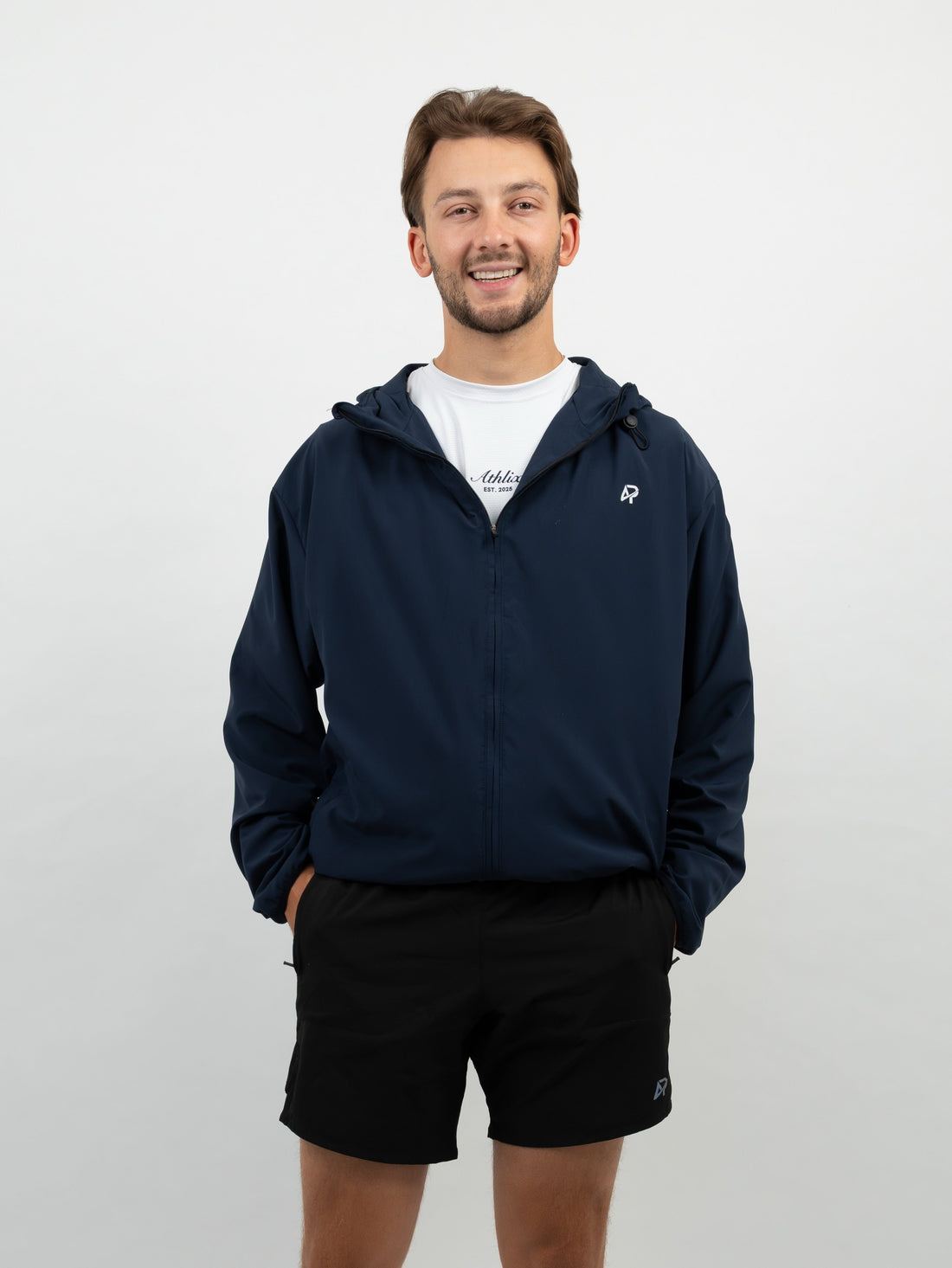
- Outer layer: windproof but breathable. A light windbreaker keeps the wind out without wrapping you up like a rain jacket. A full-length zip is worth its weight in gold: half open on the climb, fully closed into a headwind. Packable models can be tied around your waist once you are warmed up.
- Legs: stay in shorts longer than you think. Your legs generate a lot of heat when you run. Many runners stick with shorts down to around 7 to 8 °C, especially for faster sessions. Light polyester shorts with a zip pocket are ideal for that; below those temperatures it is time for long tights.

Half-open zip on the Storm Shell Windbreaker: the quickest way to regulate your temperature on the move.
The three most common autumn mistakes
The classic one is dressing for how it feels in the hallway. If you are pleasantly warm as you set off, you will sweat too much after five minutes, and it is exactly that sweat that cools you down later. Better: you should feel slightly chilly for the first few hundred metres. Mistake number two is the cotton shirt under the technical jacket. Even the best jacket does little good if the fabric underneath soaks up water and never dries again. You stay clammy in it after your run until you get home. Mistake number three is an outer layer that is too heavy. A waterproof, heavy jacket feels reassuring in drizzle but traps moisture from the inside. For most autumn runs a light, breathable windbreaker is the better choice, because it keeps out wind and light drizzle while letting vapour escape. One more tip on care: wash technical kit at 30 °C, without fabric softener and never in the tumble dryer. Fabric softener coats the fibres and slows down moisture transport.
Our layering for the weeks ahead
For runs between roughly 5 and 12 °C we combine two layers in the team: the Running Club Performance T-Shirt in 82 % polyester and 18 % elastane sits close as a base layer, dries quickly, and has flat seams to prevent chafing. Over it goes the Storm Shell Performance Windbreaker: wind-resistant, stretchy, with a full-length zip, and packable when it warms up along the way. Because it is dark blue, reflectors or a head torch belong with it after dark. Below 5 °C, add a thin mid layer and long tights.
Conclusion
In November the winner is not whoever puts on the most, but whoever layers most cleverly. A close-fitting base layer in technical fabric, a thin mid layer when needed, and a light windbreaker on top cover almost every autumn day. Start out slightly chilly, regulate with the zip as you go, and leave the cotton in the wardrobe. That way you stay dry, warm, and fast, even as the days get shorter.
Give it a try and tag us on Instagram at @athlix.performance – we would love to see how you put your autumn layering together, and we share the best posts with the community.