

Kraftausdauer
7 Workouts for Greater Muscular Endurance
- Published
- Reading time
- 3 min
- Author
- Marvin Ziegler
Muscular endurance is your muscles’ ability to perform over extended periods—and that’s exactly what makes the difference between “lasting comfortably” and “fading early.”
Whether at the gym, during a half marathon, or cycling in the mountains: muscular endurance determines how long you can stay consistently strong. Training it improves not only your athletic performance, but also your recovery and injury resilience. Here are 7 highly effective workouts to help you improve it strategically.

Squats are the foundation of every muscular endurance program.
What Muscular Endurance Really Is
Muscular endurance describes the ability to maintain or repeat a certain level of force output over an extended period. It lies at the intersection of maximal strength and endurance. A definition from the National Strength and Conditioning Association (NSCA) shows that muscular endurance can be trained with 15–25+ repetitions per set at moderate intensity.
The practical benefit: You’ll not only get fitter, but also become more resilient in everyday life, during training, and mentally. Maintaining proper form under fatigue is one of the most important qualities you can develop as an athlete.
The 7 Most Effective Workout Formats
Duration and intensity at a glance
Formats 1–2
Circuit & HIIT
20–30 min, RPE 6–9. Full-body muscular endurance and VO2 max simultaneously.
Formats 3–4
Supersets & LISS
40–75 min, RPE 5–8. Strength, volume, and aerobic base endurance.
Formats 5–6
EMOM & Pyramid
12–40 min, RPE 6–8. Time-pressured effort and progressive volume.
Format 7
Complex Training
20–30 min, RPE 7–9. Strength + endurance with the same dumbbell.
15–25+
Reps per set
2–3 ×
Per week
50–70 %
Of 1RM
Benchmarks based on NSCA training recommendations for muscular endurance.
The 7 Most Effective Muscular Endurance Workouts
Here are the seven formats you can use strategically. Integrate 2–3 sessions per week into your plan:
- 1. Circuit Training (Full Body Circuit): Full-body exercises performed back to back with short rests. Example circuit: 45 s squats, 15 s rest, 45 s push-ups, 45 s lunges, 45 s dumbbell rows, 45 s mountain climbers. 4–6 rounds.
- 2. HIIT Intervals: Improves VO2 max and speed endurance. Example: 30 s sprint / 30 s easy, 12–16 repetitions. Beginners start with 20/40. Add 10 minutes of warm-up and cool-down running.
- 3. Supersets: Two exercises without rest. Leg example: Squats (12–15) + lunges (12 per leg) performed back to back. 3–4 rounds with 60–75 s rest.
- 4. LISS (Low Intensity Steady State): 60 minutes of easy jogging or cycling at RPE 5–6 (you can still hold a conversation). Ideal for active recovery.
- 5. EMOM (Every Minute on the Minute): Start one exercise every minute. Example: 15-minute EMOM—Minute 1: 12 kettlebell swings, Minute 2: 12 burpees, Minute 3: 15 air squats, Minute 4: Rest. Repeat.
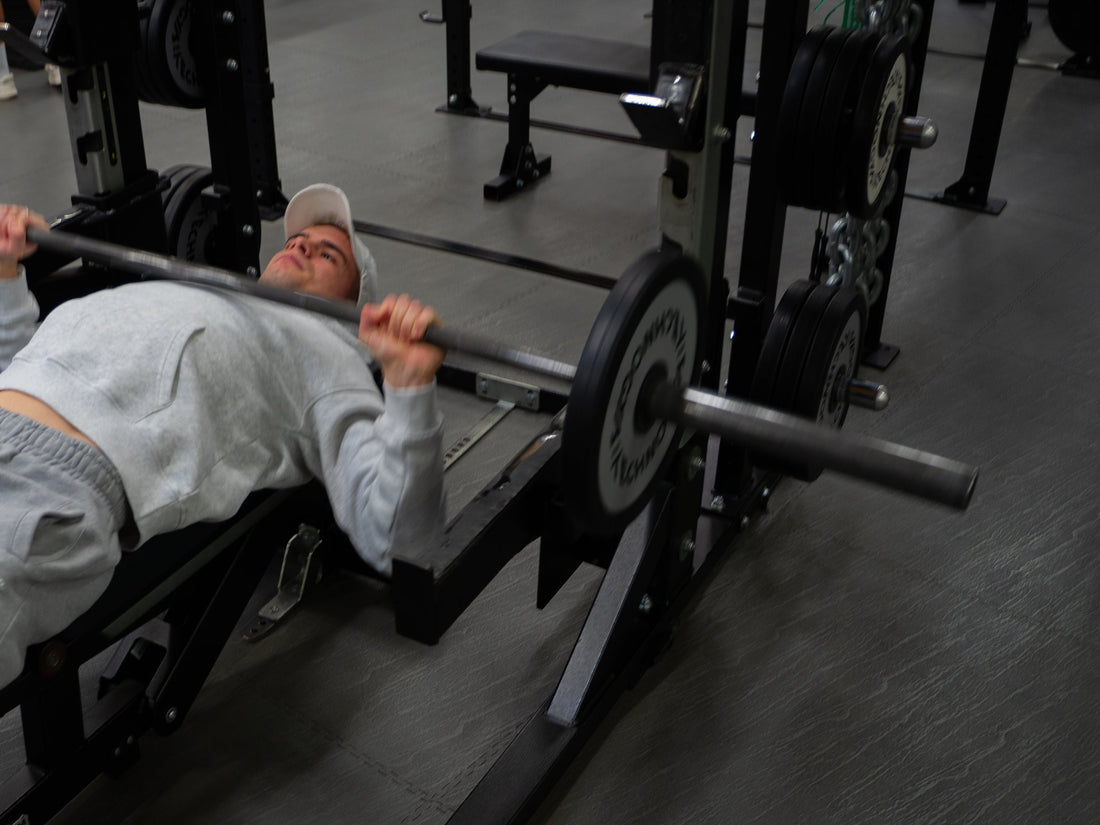
- 6. Pyramid training: Increasing and decreasing the number of repetitions. Example for the bench press: 15 light, 12 moderate, 10 heavy, 8 very heavy, then back down (10/12/15). 7 sets.
- 7. Complex training: Multiple exercises with the same barbell without setting it down. Example: 6 deadlifts, 6 cleans, 6 front squats, 6 push presses, 6 bent-over rows. Then rest for 90 s, 4–5 rounds.

Pulling exercises such as lat pulldowns keep your back and core stable even during long sets.
The most common mistakes in strength-endurance training
The biggest mistake: using too much weight for too many repetitions. Strength endurance is trained deliberately below maximum—typically at 50–70% of your 1RM. Anyone working at their limit enters the maximal-strength range and misses the actual goal: maintaining clean movement under fatigue for an extended period.
Second mistake: neglecting technique as soon as fatigue sets in. Clean execution is especially important in the final rounds. It’s better to do two fewer repetitions with good form than five more with your form collapsing.
Athlix recommendation—the right gym setup
Long gym sessions require the right setup. A clean Athlix T-shirt as a base and an Athlix hoodie for warming up and after training are your recovery setup for demanding strength-endurance sessions. Especially during Swiss winters: sweating indoors and freezing outside—you don’t have to. With the right layers, your body stays in training mode.
Conclusion
Strength endurance determines whether you can sustain your performance through to the end. The seven featured workouts—from circuit training and HIIT to complexes—cover every area: maintaining technique, working under time pressure, completing long sets, and developing mental strength. Incorporate 2–3 sessions per week, start moderately, and increase gradually. You’ll not only get fitter but also become more resilient in everyday life.
Try it out and tag us on Instagram at @athlix.performance – we love seeing how you build your strength endurance, and we share the best posts with the community.